


Introduction
NLP-as-a-Service (NLPaaS) refers to cloud-based platforms that provide natural language processing capabilities through APIs and SDKs, and platform interface. This allows users to integrate language understanding into applications without building and training NLP models from scratch. These services make advanced language tools widely accessible by removing the need to manage complex machine learning workflows, enabling developers, researchers, and businesses of any size to easily leverage NLP capabilities. The core value of NLPaaS lies in its scalability, ease of integration, and the ability to process unstructured text data at scale.
One of the key motivations for this evolution is the explosion of unstructured textual data—from social media, news, emails, and more. Traditional NLP systems often struggled to process such massive and messy datasets. Cloud-based NLP platforms, however, provide the infrastructure to handle big data, process it in real time, and scale resources as needed.
Benefits and Challenges
At the heart of most NLPaaS offerings are APIs that enable various linguistic tasks such as named entity recognition (NER), sentiment analysis, part-of-speech tagging, language detection, text classification, and machine translation. For example, a company might use sentiment analysis APIs to monitor public opinion across product reviews, or employ NER to extract organization names from news articles.
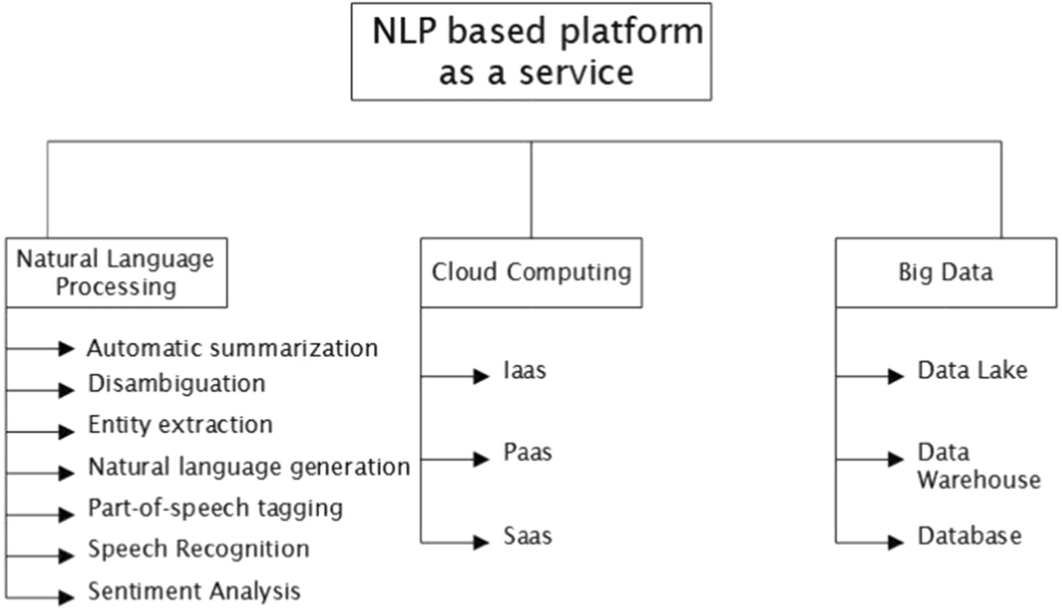
Pais et al. (2022) explain how existing commercial cloud NLP services—such as Amazon Comprehend, Google Cloud Natural Language, and Microsoft Azure Cognitive Services—are shaping this space. These services offer pre-built NLP functions via APIs, making it easier for developers and businesses to integrate language understanding into their applications.
The authors also proposed a reference architecture for platform offering NLPaaS, showing how such a system can be built. This includes frontend interfaces for users and backend infrastructure for processing, managing data, and deploying models. The platform needs to handle data ingestion, transformation, storage, model training, and prediction in a modular, scalable manner.
To ensure smooth operation, the paper highlights the need for parallel processing, load balancing, and security protocols. NLPaaS systems should also allow users to deploy custom models or choose from existing ones. This flexibility would appeal to both technical and non-technical users, ranging from data scientists to business analysts.
It is important to consider methodological support for application development on NLP platforms. Users should be able to rapidly prototype solutions, iterate on models, test performance, and scale to production without handling all the infrastructure complexity themselves. This SaaS-like approach saves time and encourages experimentation.
One of the key challenges is processing unstructured data at scale. Unlike structured data in databases, text is noisy and unpredictable. The paper emphasizes the importance of strong data cleaning, annotation, and normalization pipelines to prepare text data before applying NLP techniques.
Pais et al. (2002) conclude that the future of NLP applications lies in fully-managed cloud platforms that hide infrastructure complexity while offering powerful, customizable language tools. These systems will allow users to build smarter applications and analyze language data at scale—whether for business insights, academic research, or automated services.
AI-enabled cloud platforms can combine artificial intelligence—like machine learning, natural language processing, and computer vision—with cloud infrastructure to simplify and speed up app development. Chen and Li (2025) detail how they help automate tasks, improve workflows, and support smarter decision-making. By offering scalable resources and powerful analytics, these platforms make it easier for developers to build intelligent applications quickly. Importantly, they also make advanced AI tools accessible to businesses of all sizes, helping them innovate and stay competitive in the digital age.
Service Providers
In addition to the big players, there are also specialized providers like SpaCy via Explosion AI, Hugging Face’s Inference API, and NewsAPI.ai, which offer more targeted or customizable NLP solutions. These often appeal to organizations that require domain-specific customization, such as legal document analysis, financial reporting, or healthcare records processing. Some even allow fine-tuning or uploading of custom models while still providing the convenience of API-based access.
NLPaaS also plays a pivotal role in real-time analytics and event detection. Platforms like Event Registry’s NewsAPI.ai (more details provided below) enable real-time tracking of news narratives, sentiment shifts, and topic clustering by delivering NLP-enriched metadata from thousands of global news sources. These capabilities support use cases in crisis monitoring, media intelligence, and geopolitical risk analysis, where speed and accuracy are paramount.
A key benefit of NLPaaS is its ability to reduce development costs and time-to-market. Organizations no longer need to hire large NLP teams or manage their own data pipelines. Instead, they can plug into mature, battle-tested APIs that offer best-in-class performance and are constantly updated with the latest advances in natural language understanding. This is especially useful for startups or product teams who want to rapidly prototype AI features.
Customization and domain adaptation are becoming increasingly important in NLPaaS. While generic models are useful for general tasks, many industries require specialized knowledge to perform well—for example, legal, medical, or scientific language. To meet this demand, some providers offer custom model training or fine-tuning, letting users tailor models to their own data while maintaining the ease of cloud deployment.
Security and compliance are critical considerations in enterprise adoption of NLPaaS. Leading providers now offer data privacy controls, encryption, and regulatory compliance features such as GDPR alignment or HIPAA readiness. These safeguards are especially important when processing sensitive documents, personal messages, or proprietary business content through cloud services.
As large language models (LLMs) like GPT, BERT, and T5 are increasingly being offered via inference APIs, the line between traditional NLPaaS and LLM-as-a-Service is beginning to blur. These newer models offer more advanced capabilities such as summarization, question answering, semantic search, and few-shot learning. NLPaaS providers are integrating these models into their platforms to offer richer and more nuanced language understanding services.
Case Studies
RavenPack
RavenPack, a prominent provider of NLP-based news analytics, has taken a pragmatic and technically grounded approach to the rise of LLMs and generative AI. Unlike some vendors that have rushed to integrate tools like ChatGPT, RavenPack has maintained a cautious stance, recognizing both the potential and complexity of these technologies. The company views LLMs not as an immediate threat but as sophisticated systems that still require deep NLP domain knowledge to be deployed effectively.
RavenPack emphasizes that successful integration of LLMs requires more than just API access to OpenAI tools; it demands the expertise to build and fine-tune transformer architectures—something that many data providers may not have in-house. This view underscores RavenPack’s strength in traditional NLP and its belief that domain-specific knowledge remains critical in financial analytics, particularly where precision, explainability, and compliance are essential.
While others moved quickly to embed GPT APIs for customer-facing features or to cut internal costs, RavenPack continued to rely on its proprietary NLP pipeline. This includes entity detection, sentiment analysis, novelty scoring, and event extraction based on professionally sourced financial news—ensuring consistency and accuracy over black-box unpredictability.
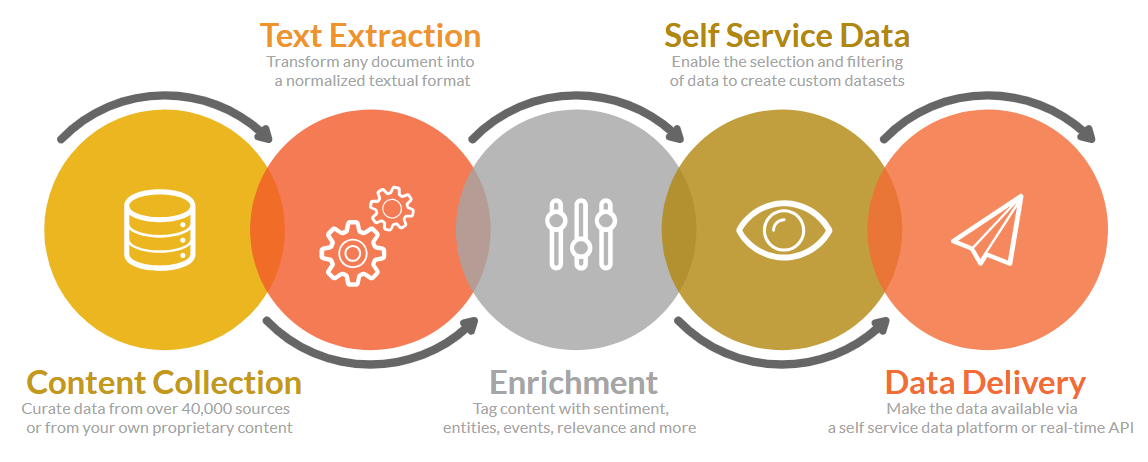
Any document—regardless of its origin or format—is converted into a clean, normalized textual form. This standardization is crucial for downstream analytics and allows seamless comparison and aggregation across heterogeneous sources. Once standardized, the content is enriched with structured metadata. RavenPack tags documents with sentiment scores, key entities (e.g., companies, people, locations), event classifications, and relevance indicators. This transforms narrative content into quantifiable signals.
Users can filter, customize, and build their own datasets through an intuitive self-service interface. Whether tracking a set of companies, topics, or event types, clients have granular control over what data they consume and how.
Aware of the industry momentum, the company has engaged in exploratory initiatives involving transformer models and advanced embeddings. These efforts are likely aimed at strengthening its technology stack, preparing for eventual LLM integrations that meet their high standards for control, traceability, and interpretability.
RavenPack’s continued leadership in news analytics positions it well to eventually enhance its offerings with LLMs in a meaningful way. With a vast historical database and structured annotations, the company is already sitting on a goldmine of labeled data—ideal for training or fine-tuning specialized models for finance-specific tasks.
This measured and infrastructure-first approach contrasts with fast-moving startups but aligns with RavenPack’s brand as a premium data provider trusted by top-tier hedge funds, banks, and asset managers. As the LLM ecosystem matures, RavenPack may become a major player in developing vertical-specific models that combine transformer power with institutional-grade reliability.
EventRegistry and NewsAPI.ai
Event Registry is a leading media intelligence platform that specializes in structured news analysis at scale. Its core product, NewsAPI.ai, delivers real-time and historical news metadata enriched through NLP. This service helps developers, analysts, researchers, and data buyers extract meaningful insights from over 150,000 global news sources, supporting more than 60 languages.
NewsAPI.ai is designed for deep analysis across geographies and topics. It offers NLP features like sentiment analysis, entity recognition, event clustering, and concept extraction, along with access to a historical archive that dates back to 2014. These capabilities empower users to investigate how events are covered around the world and to extract intelligence from both breaking and long-term news cycles.
One of NewsAPI.ai’s standout features is its support for cross-border sentiment and narrative analysis. It allows users to study how the same global event is reported differently across countries and media outlets. By clustering articles about a single event, users can analyze sentiment variations, differences in article prominence, and the entities emphasized by each region. This is especially valuable for organizations investigating media bias, disinformation, or public perception.
NewsAPI.ai also uses event-level clustering to group articles from different publishers that cover the same real-world event. For instance, it tracked the global coverage of the MiCA regulation (EU crypto framework) across English-language media in the EU from October 2023 to April 2025. While the event was consistent, differences in sentiment and entity focus revealed how the narrative shifted across outlets.
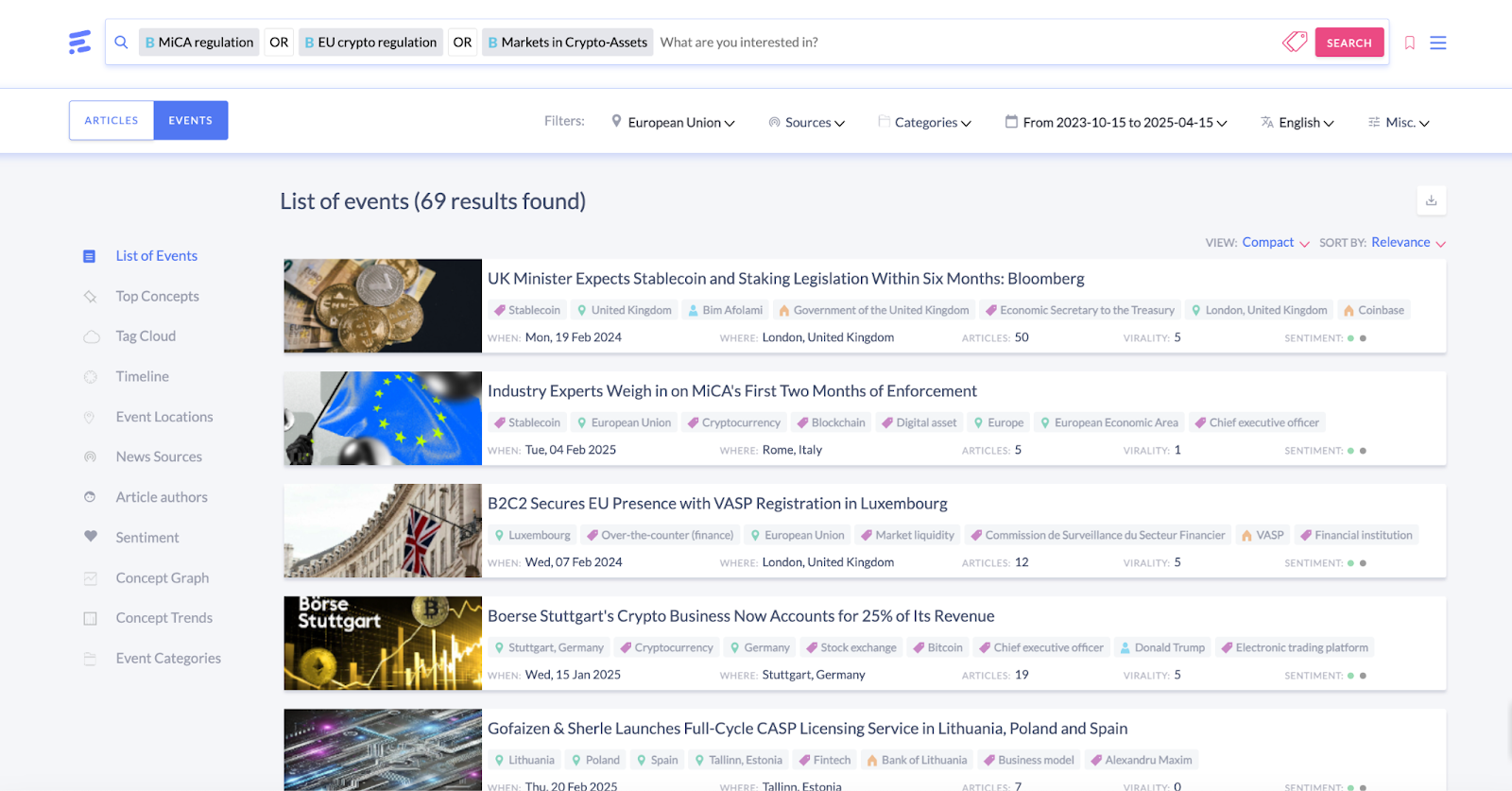
Another example involves the automotive industry, where NewsAPI.ai clusters stories about restructuring, semiconductor trends, or policy changes into time-based events. These clusters are enriched with metadata such as sentiment, geolocation, virality, and entity tags, providing an end-to-end view of how stories develop and spread in the sector.
Industry intelligence and competitive positioning is another major use case. Businesses can track developments within their sector and monitor how their company or competitors are portrayed in the media. With customizable source lists and taxonomies, users can assess media volume, visibility, and sentiment trends over time—crucial for strategic planning, reputation management, and benchmarking efforts across industries such as finance, energy, and tech.
In addition to real-time data, NewsAPI.ai provides custom historical data services. Clients—including international agencies and public institutions—can request bulk extractions for long-term trend analysis. These archives support economic modeling, narrative forecasting, and regional media comparisons. For example, one public-sector organization used historical data from Africa and Southeast Asia to assess regional economic trends.
Whether powering real-time alerts, long-term analysis, or cross-border comparisons, NewsAPI.ai transforms unstructured news into structured, actionable insights. Built for scale and designed with flexibility in mind, it offers everything from developer-friendly APIs to custom data exports for institutional research. The API is available via REST, Python, and Node.js, with comprehensive documentation to ensure smooth integration for any technical team.
Orbit
Orbit Insight leverages NLP and AI to transform unstructured data into structured, machine-readable insights. By converting raw data into a standardized knowledge base, Orbit enables powerful automation and analysis capabilities using LLMs. This structure is essential for intelligent workflow automation, allowing teams to significantly reduce the time and effort required to extract value from data. Instead of manually combing through documents or spreadsheets, users can rely on Orbit’s platform to surface meaningful insights quickly and reliably.
A core feature of Orbit's offering is the Orbit Bot Marketplace—a growing ecosystem of intelligent bots built to automate a wide range of tasks. These bots are not generic tools; they are flexible and customizable, adapting to each organization’s specific workflows and needs. Whether the task involves data analysis, report generation, or predictive modeling, Orbit bots streamline complex processes with accuracy and precision. This automation not only boosts operational efficiency but also reduces human error and empowers teams to concentrate on making strategic, informed decisions.
Orbit’s platform also handles large-scale data processing and complex calculations. Its automation infrastructure can process vast datasets with speed and consistency, making high-volume, high-complexity analysis simple and scalable. This capability ensures that even organizations managing massive amounts of data can still derive timely, accurate results—enabling faster, better decision-making.
The platform is built for adaptability. Orbit allows users to integrate new data sources, explore novel analytical models, and customize reporting according to their specific objectives. This level of flexibility means that Orbit isn’t just a static tool—it’s a partner in innovation. Whatever the user's vision, Orbit bots can be configured to bring that vision to life, unlocking new levels of efficiency and insight.
Orbit empowers users to automate complex processes that once required extensive manual effort. The result is a significant boost in productivity, accuracy, and agility for professionals who need to extract value from unstructured data at scale.
At the core of Orbit Insight’s automation capabilities are three foundational components: universal metadata, machine-readable data, and a batch calculation platform. Together, these form the building blocks for scalable and intelligent workflow automation.
First, Universal Metadata provides a consistent organizational framework across all data processed by the platform. Every document, data point, or record is tagged with standardized metadata—such as entity names, dates, or document types—enabling fast, precise retrieval. This consistency is crucial for NLP tasks, as it ensures that downstream processes can rely on well-structured input without ambiguity or data fragmentation. Whether users are sorting filings by company, pulling sentiment analysis by topic, or clustering documents by type, the metadata framework guarantees that workflows run efficiently and accurately.
Second, high-quality, machine-readable data is a pillar of Orbit’s automation engine. Unstructured documents, including complex PDFs, are pre-processed and converted into formats optimized for NLP. Metadata is extracted, language is normalized, and semantic structure is applied—turning raw content into a format that machines can easily understand. This step eliminates the need for time-consuming manual data wrangling and significantly reduces the risk of error, making even legacy or low-quality sources usable in high-performance workflows.
Third, Orbit's batch calculation platform is built to handle high-volume, computationally intensive tasks through parallel processing. This system ensures that large-scale calculations—such as trend analysis across thousands of financial reports—can be executed efficiently and with minimal latency. Whether users are backtesting hypotheses, generating forecasts, or evaluating risk scenarios, the batch engine delivers reliable and timely output, transforming what was once a bottleneck into a scalable capability.
Adding to its accessibility, Orbit integrates ChatGPT as a conversational interface. This feature allows users to interact with data in plain language, eliminating the need for technical expertise to conduct sophisticated analysis. Whether asking questions, generating summaries, or initiating in-depth investigations, users can rely on a natural, dialogue-based approach to analytics. This makes data-driven decision-making intuitive and inclusive, extending the power of Orbit to more people within an organization.
Conclusion
The rise of NLP-as-a-Service (NLPaaS) marks a transformative moment in how organizations interact with text data, offering scalable, flexible, and accessible tools for natural language understanding. From traditional cloud NLP platforms like Amazon Comprehend and Google Cloud Natural Language to specialized offerings like RavenPack, NewsAPI.ai, and Orbit Insight, the ecosystem is evolving rapidly to meet the growing demand for real-time analysis, domain-specific customization, and seamless integration into enterprise workflows.