


This is a guest article submitted by Bryan Fok and Gregory Roumiantsev, Research Analysts at AlphaROC, an AI-native market research and intelligence company.
Introduction
Conventional wisdom dictates that a political party is rewarded electorally based on economic conditions. Generally, the incumbent political party wins elections when economic conditions are strong and loses when economic conditions are weak. The 1992 and 2008 presidential elections saw challengers defeating the incumbent party due to ongoing recessions, and Ronald Reagan resoundingly won reelection in 1984 due to a booming economy.
However, the 2024 presidential election demonstrates that a strong overall economy does not guarantee the incumbent party staying in power. Despite no recession occurring during the campaign and real per-capita growth during the Biden administration outpacing that of the previous two administrations, which are two of the thirteen “keys to the White House,” the Democratic Party failed to retain the presidency. Instead, many voters reported feeling dissatisfied with the state of the economy.
This gap between what's reported and what people feel shows that Americans’ economic sentiment can diverge sharply from actual macroeconomic indicators, and that this trend is worth tracking because it affects election outcomes. Using AlphaROC’s Occam data, this report examines how Americans’ views of current and future business and employment conditions have shifted over the years and how they have changed relative to macroeconomic indicators. The data shows that during Biden’s presidency, indicators weakened by Election Day even though economic indicators improved, and now in 2026 sentiment continues to deteriorate even though the employment rate remains relatively unchanged. This report closes by considering what this may mean for the upcoming 2026 Midterm elections.
AlphaROC
AlphaROC is an AI-native market research company that utilizes human data to provide insights to institutional investors and policy professionals. Through its Edwin platform, it interviews thousands of people daily to gather information on macro trends, consumer sentiment, and public opinion. The data from these studies can be found in Occam, its data visualization platform, which is a repository of over 5,000 longitudinal trackers. AlphaROC also offers bespoke studies that can target specific populations, including professionals in specific industries, to provide investors with precise data.
The data used in this report comes from various trackers on Occam that gauges the views of Americans on the current and future state of the economy. The data has been collected since 2021, but the included charts highlight specific relevant time frames. The data is collected on a daily basis, and each data point has a sample size of at least 1,000 respondents.
Understanding Past Elections Through the Vibe Economy
The term ‘Vibe Economy’ or ‘Vibecession’ was coined by economic commentator Kyla Scanlon, and refers to the phenomenon that there is a disconnect between what the actual macroeconomic indicators are versus how people feel the economy is doing. The 2012 and 2024 presidential elections are useful ways to understand the phenomenon of ‘the Vibe Economy’, as they were, on paper, similar economic environments, each inheriting a struggling economy and beginning to turn it around. However, public sentiment on the economy differed, contributing to different electoral results. The incumbent Barack Obama won reelection comfortably in 2012 while the Democrats led by Kamala Harris failed to retain the White House in 2024.
Looking back at Obama’s first term from 2009 to 2013, much of it was defined by inheriting a poor economy after the Great Recession. At its worst, the unemployment rate was at 10% in October of 2009. By the November 2012 election, the unemployment rate had fallen to a still-high 7.7%. However, Americans’ outlook on the economy remained high, as the Michigan Sentiment Survey went from 61.2 in January 2009 to 82.7 by November 2012. Despite the discrepancy between actual economic conditions and perceptions of the economy, Obama won reelection with 332 electoral votes.
The economy was in a much stronger position in 2024 compared to 2012, but the Democrats lost the presidency that year. After taking office in 2021, Biden’s term was marked by much of the economic fallout from the COVID-19 Pandemic. Unemployment started at 6.4% in January of 2021, but by November 2024 it had fallen to 4.2%. Inflation, which rose to 9.1% in June of 2022, had fallen to 2.7 by November of 2024. In fact, Allan Lichtman, who correctly predicted 9 of the 11 presidential elections since 1984 using his “keys to the White House” methodology, predicted that the Democrats would retain the presidency in 2024 partially because there was no recession during the election campaign and because real per-capita growth during the Biden administration outpaced that of the last two presidential terms. By these measures, Democrats should have been favored to win, which suggests that one of the missing pieces may be how Americans perceived the economy to be doing.
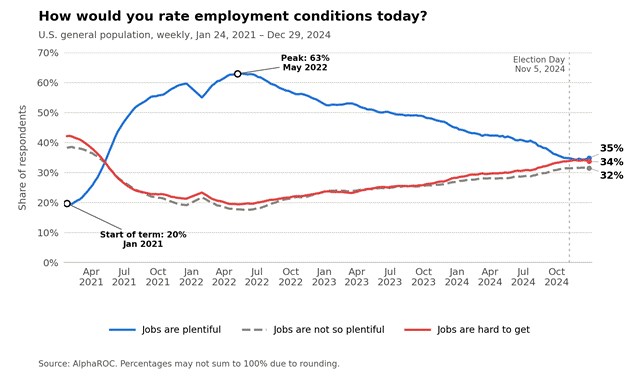
Occam’s data points to this perception disconnect. As exemplified by Figure 1, Americans’ view of the job market had fallen since its peak in May of 2022, when 63% of people said jobs were plentiful, which deteriorated to 35% in November of 2024 on Election Day. Views on the next 6 months followed a similar pattern. Only 32% expected improvement in the next 6 months, down from a peak of 44% in May 2021. Even though the labor market had improved considerably since January 2021, voters’ sentiment by 2024 may have remained soured due to a sharp rise in prices in 2022. Although perceptions of the job market are not the only reason democrats lost in 2024, it is clear messaging of a ‘soft-landing’ did not land with many voters. This is further supported by looking at the Michigan Consumer Sentiment data, which shows by November 2024, despite many ups and downs, sentiment was sitting at 71.8, down from the start of Biden’s presidency (79.0) and from its peak in April of 2021 (88.3).
Understanding 2026 through Occam Data
Occam’s weekly macroeconomic tracker both measures how employment and business conditions feel currently, and how it is expected to change over the next 6 months. Figures 2-4 highlight how sentiment has changed between the beginning of 2024 and October 2026, coinciding with the 2024 presidential campaign and the 2026 midterm campaign seasons.
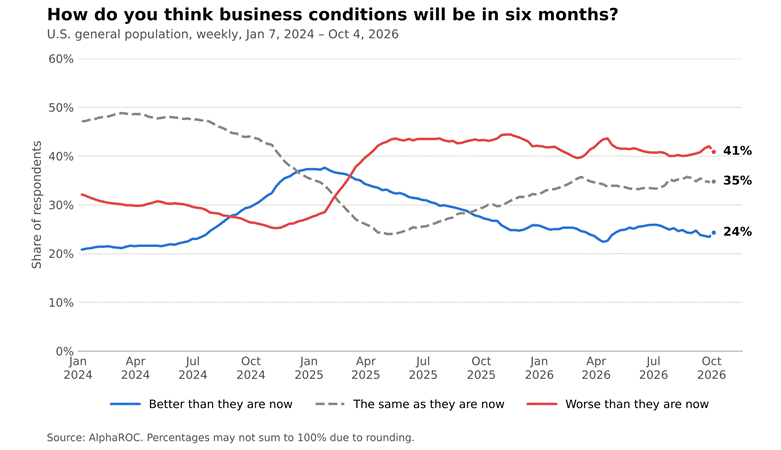
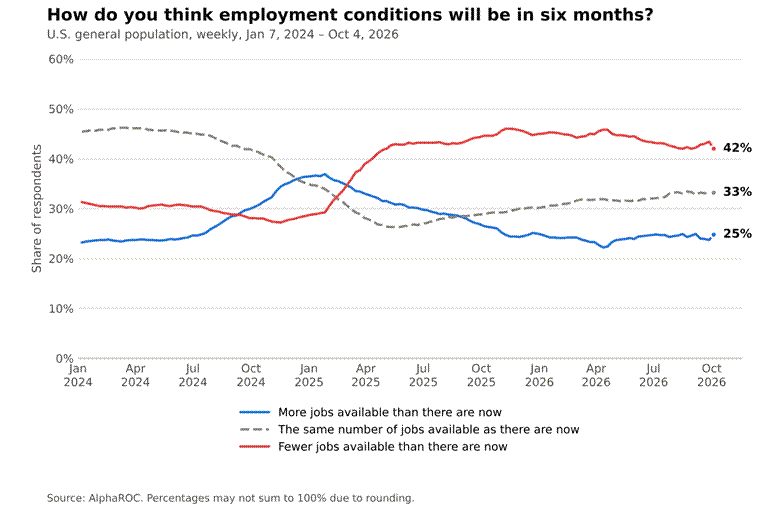
Occam data supports the hypothesis that voters blamed a perceived poor economy on the Biden administration. When asked about future business and employment conditions, the share of Americans who expect business and employment conditions to improve experienced a notable uptick during the lame duck period of late 2024 and early 2025. The data suggests that many Americans were optimistic that the incoming Trump administration would lead to better economic conditions. However, the positive future outlook on the economy peaked in early 2025, and steadily decreased throughout the year, stabilizing in 2026, showing that Americans’ optimism in the incoming Trump administration quickly faded.
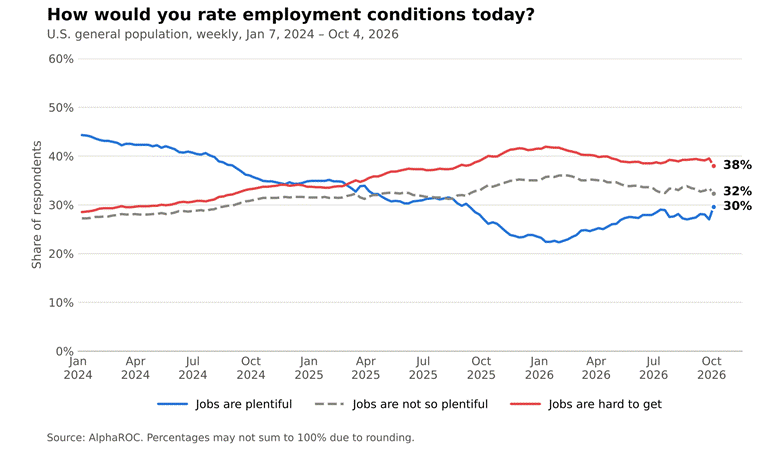
Since Donald Trump took office in January 2025, perceptions of current business and employment conditions have begun to sour. That is despite the actual unemployment rate changing little–from 4.0% in January 2025 to 4.2% in October 2026. Looking at January of 2025, the U.S. general population rating business conditions as poor has increased from 41% to 48%, and those rating employment conditions as hard to get a job have also increased from 34% to 38%.
Occam data showing what U.S. citizens think six months out shows an even more pessimistic trend. In January of 2025, around 37% of respondents expected better business conditions, while only 28% expected worse. Similarly, 37% expected more jobs, while 29% expected fewer. However, since April of 2025, these markers have reversed, and heading into the midterms, around 41% of people expect business conditions to get worse, compared to 24% expecting them to get better, and 42% think employment conditions will get worse, with only 25% thinking they will get better.
Despite employment remaining at similar levels, Americans could be getting this pessimism from rising prices, as since February of 2026 CPI has risen from 2.6% to a peak of 4.2% in May, now sitting at 3.4% in August. However, as our data shows, an increase in pessimism has been noticeable since Spring of 2025, which is a whole year before any shifts in inflation.
What This Means for Midterms
While this may make it seem like Republicans are hopeless heading into November, midterm elections often play out very differently from general presidential elections. Although Republicans may be facing an uphill battle as AlphaROC data suggests and sentiment remains very negative, Democrats were in a similar position in 2022 and ended up overperforming expectations. In 2022, CPI peaked at 9.1%, and the Michigan Consumer Index hit its lowest-ever recorded point in June 2022 up until that point.[12] Despite this, Democrats lost only 9 seats in the House, giving Republicans an 8-seat majority, and the democrats gained 1 senator, leaving them still with a 51-49 majority.
Despite election results, there is a clear growing gap in what the people feel versus what the economy actually is. That is clear from analyzing Occam data on economic sentiment alongside key macroeconomic indicators. This phenomenon is not only important to political parties wanting to win elections, but also policymakers, businesses, and investors who use key job reports to make key decisions as ‘vibes’ of the economy shape spending decisions, political support, and saving trends. There is much to examine about the causes of this sentiment shift, but its impact on elections should not be ignored.